


- Home
- Sustainability

UK Carbon Reduction Plan April 2025
- Filename
- Carbon-Reduction-Plan-April-2025.pdf
- Size
- 113 KB
- Format
Sustainability
We're taking action to drive sustainability – for the health of people, society and the planet.

UK Carbon Reduction Plan April 2025
- Filename
- Carbon-Reduction-Plan-April-2025.pdf
- Size
- 113 KB
- Format
Our approach on climate, equity and resilience
We are harnessing the power of science and innovation in ways that positively impact more patients and healthcare systems while reducing our impact on the environment. We are working towards absolute reductions in all our direct and indirect greenhouse gas (GHG) emissions sources across the value chain – scopes 1, 2 and 3 – and decoupling carbon emissions from revenue growth.
We are advancing our sustainability priorities across the interconnected dimensions of climate and nature, focusing on mitigating the impacts of climate change, restoring and protecting nature, building resilient health systems and improving health equity.
We are delivering on our sustainability strategy through three priorities

We reduce health inequalities
No patient should be denied rapid, equitable access to high-quality, evidence-based care. We advocate for reform and work with local partners to pilot and scale innovations that drive practice change to address the areas of greatest need in the UK. We can help address health inequalities and provide solutions along a continuum of care – from prevention, awareness, living well with and after their diagnosis, and through treatment.

We protect the environment
Through pioneering science, we want to deliver patient-centric, transformative, net zero healthcare that has a positive impact on people, society and the planet. We were one of the first seven companies worldwide to have our net zero, science-based targets verified under the Science Based Targets Initiative Net-Zero Corporate Standard.
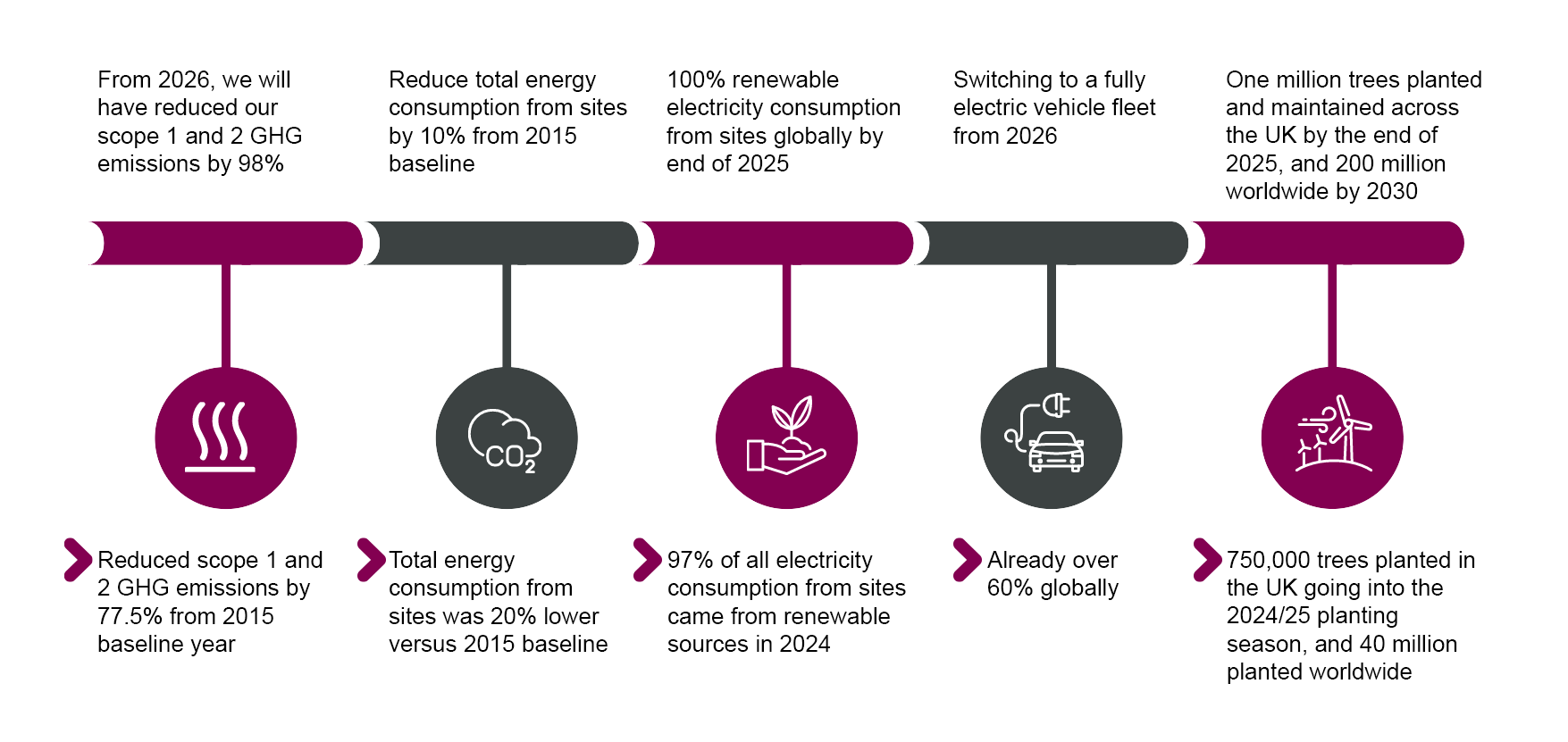
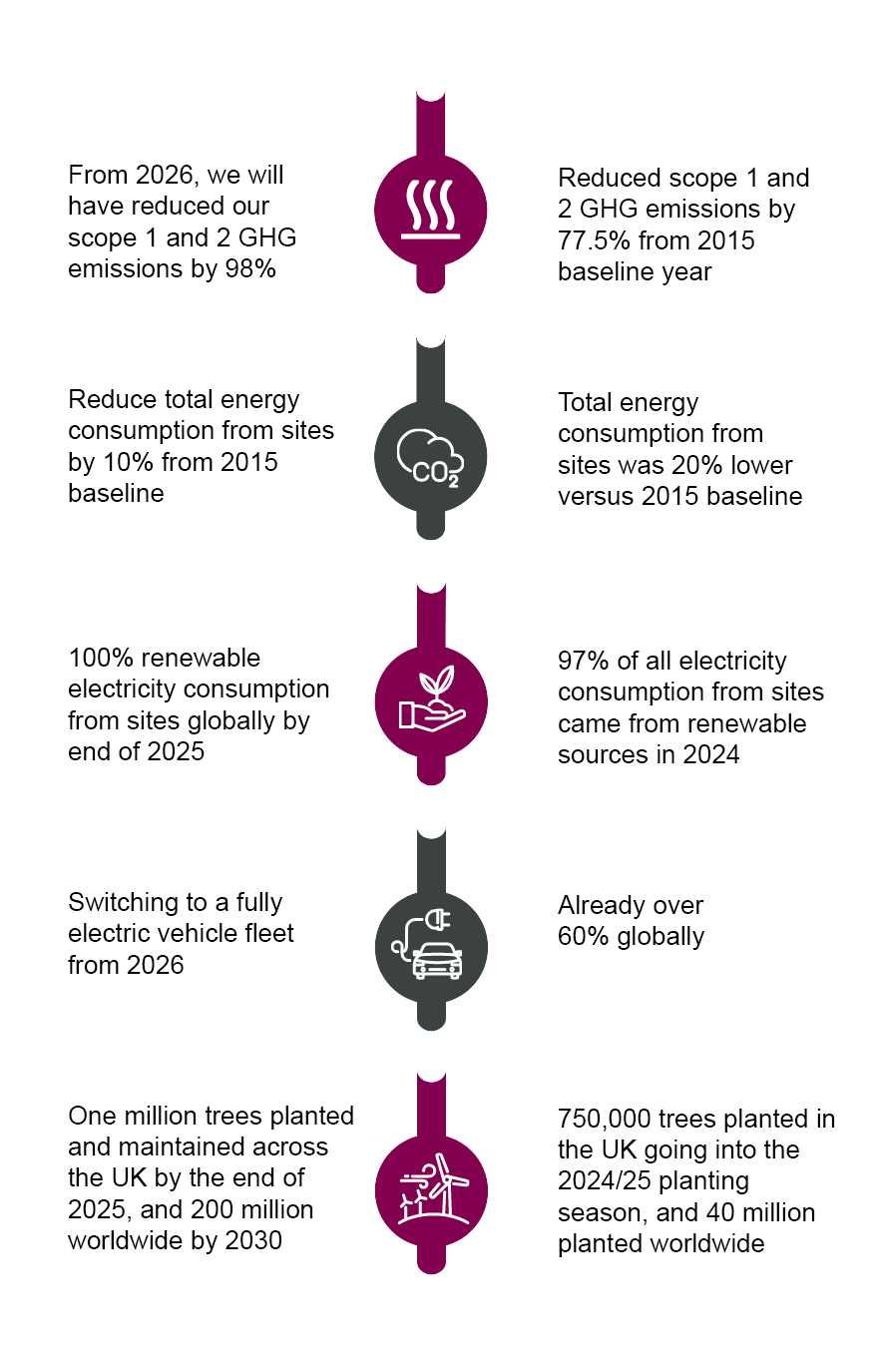
Through our flagship Ambition Zero Carbon programme, we are on track to reduce greenhouse gas (GHG) emissions from our global operations (scope 1 and 2) by 98% by 2026 (from a 2015 baseline) – by the end of 2024 we had achieved a 77.5% reduction. We aim to halve our entire value chain footprint by 2030 on the way to a 90% reduction and science-based net zero by 2045 (from a 2019 baseline).
See our Carbon Reduction Plan here.

We invest in our people and communities
At AZUK we are committed to creating the conditions for our people to perform, grow and engage, enabling AZUK to achieve our strategic ambition. Underlying this commitment is a core belief that the success, health, safety, wellbeing and engagement of our people is critical for AZUK’s success.
Community engagement at AstraZeneca is built upon the principles of equity, transparency and partnership, and we work together to build healthy and resilient communities. Our human rights policies are designed to ensure we consider the impact of our operations on all human rights including those of the communities around our operations. The output of our work to mitigate human rights risks is detailed in our Modern Slavery Statement, which is published annually.
Find out more about our early career and gender pay report here.
Find out about our investment in STEM programmes here.
Our goals and progress
Ambition Zero Carbon
In 2020, we launched our Ambition Zero Carbon strategy, through which we are pursuing ambitious science-based decarbonisation targets and making progress towards achieving net zero by 2045. We also aim to become carbon negative from 2030 for all residual GHG emissions.
Ambition Zero Carbon encompasses many programmes of work throughout our value chain. From the launch of The Discovery Centre in Cambridge - occupied by 2,200 scientists and yet in 2024, having the carbon footprint of two UK households due to heating and cooling from 174 boreholes harvesting geothermal energy from beneath the site - to playing a central role in the Sustainable Markets Initiative’s Health Systems Task Force. This global public-private partnership takes action at scale on patient care pathways and supply chain decarbonisation, for example recently securing a renewable power programme in China that could result in annual emissions savings equivalent to taking 50,000 cars off the road.
Moving to 100% renewable energy
Transitioning to 100% renewable energy for heat and power is core to AstraZeneca’s Ambition Zero Carbon commitment having joined Climate Group’s RE100 campaign in 2015. Heat and power are critical to the manufacture of medicines so decarbonising the healthcare supply chain depends on access to clean sources of heat.
AstraZeneca is the first company in the UK committed to using biomethane at scale to fuel the discovery, development and manufacture of medicines. The Moor Bioenergy plant in Lincolnshire will supply 100 GWh of renewable energy annually to AstraZeneca UK, equivalent to 20% of the company’s total global gas consumption, displacing approximately 18,000 tonnes of carbon dioxide equivalent (CO2e) emissions per year from fossil gas.
Switching to a fully electric vehicle fleet (EV100)
At the end of 2024 we had successfully transitioned 63% of our total global owned and leased road vehicle fleet (over 20,000 vehicles) to battery electric vehicles (BEVs), with the UK achieving 87%. Our fleet accounted for 23% of our scope 1 and 2 GHG footprint in 2024. By investing in BEVs, we’re reducing harmful emissions and promoting cleaner air, helping to reduce pollution-related respiratory diseases and other related conditions.
Decarbonising care pathways
We are partnering with the NHS to decarbonise care pathways in a number of therapy areas, creating evidence and building environmental impact assessment tools to develop evidence that guideline directed medical therapy improves outcomes and reduces emissions.
The climate crisis is the largest health issue of our time and has a significant impact on respiratory diseases which can be complex, difficult to treat, often poorly controlled and associated with a higher carbon footprint of care.
The SABINA CARBON UK study is a key part of our Ambition Zero Carbon commitment, in which we presented real-world evidence in a first-of-its-kind study, demonstrating that uncontrolled asthma generated three times more GHG emissions than well-controlled asthma.i The study showed that excess GHG emissions due to suboptimal asthma control included three or more prescriptions of short-acting beta2-agonist (SABA) inhalers per year.ii
SENTINEL PLUS: This on-going quality improvement initiative has been co-developed with clinicians and patients to improve asthma outcomes while reducing SABA-over reliance. To date, 44,275 fewer blue inhalers have been issued, saving 1,240 metric tonnes of carbon emissions, equivalent to 39,600 ambulance responses.iii,iv
Find out more about SENTINEL here.
Next generation propellants for respiratory inhalers: In asthma and COPD, the propellant gases in pressurised metered dose inhalers (pMDIs) represent 3% of the entire carbon footprint of the NHS and a significant proportion of AstraZeneca’s scope 3 emissions.v From 2025 we are transitioning our inhaled medicines to a next-generation propellant with near-zero global warming potential – 99.9% lower than current propellants.vi
Delivering a net zero NHS
Through the Climate Change Act 2008 the UK is legally bound to achieving net-zero greenhouse gas emissions by 2050, meaning a 100% reduction from 1990 levels. The NHS has committed to reaching net zero by 2040 for the emissions it controls directly, and by 2045 for the emissions it influences, through the goods and services it buys from partners and suppliers.
NHS England Evergreen Maturity Level 4
NHS England’s Evergreen Sustainable Supplier Assessment is a self-assessment and reporting tool built into the NHS-wide e-procurement system. AstraZeneca has received a Level 4 showing we have 2045 net zero targets that are independently validated, across the global organisation. Evergreen is one of several NHS initiatives designed to support its net zero and wider sustainability objectives. We are delighted to be supporting the NHS to achieve their net zero and sustainability ambitions, including those set out in the NHS Net Zero Supplier Roadmap.
Value chain decarbonisation
As part of our Ambition Zero Carbon strategy, we are engaging with our suppliers to support them to set validated science-based GHG emissions targets (SBTs). We are active participants of the Pharmaceutical Supply Chain Initiative (PSCI), the vision of which is to drive excellence in safety, environmental and social outcomes, across the global pharmaceutical and healthcare value chain. Additionally, AstraZeneca is a founder member of the Sustainable Markets Initiative’s Health Systems Task Force which is taking action at scale, focusing on four priority areas including supply chain decarbonisation. Our Supplier Diversity Programme maximises opportunities for small and diverse businesses to be part of our value chain and supports their growth.
AZ Forest
We are investing $400 million in the global AZ Forest programme to restore nature, benefit local communities and compensate for residual emissions. We are aiming to plant more than 1 million trees in the UK by the end of this year, in collaboration with Forestry England.
Find out more about our AZ Forest here.
- Wilkinson AJK, Maslova E, Janson C, et al. Greenhouse gas emissions associated with suboptimal asthma care in the UK: the SABINA healthCARe-Based envirONmental cost of treatment (CARBON) study. Thorax 2024;79:412-421
- Wilkinson AJK, Maslova E, Janson C, et al. Results from SABINA CARBON. Greenhouse gas emissions associated with asthma care in the UK. Eur Resp Soc Intl Congress 2021
- Royal College of Physicians. Sentinel Project. Available online
- Scoping ambulance emissions: recommendations for reducing engine time. Available online
- Improving health outcomes for respiratory patients while reducing carbon emissions, NHSE. Available online
- Pritchard J. The climate is changing for metered dose inhalers and change is needed. Drug Des Devel Ther 2020;14:3043-3055
GB-66006 | DOP: April 2025


GB-69529 | DOP: August 2025
© AstraZeneca 2023
GB-69529 | DOP: August 2025
© AstraZeneca 2023