


- Home
- Partnerships
- Partnering in the UK
Partnering in the UK
Scroll through to learn about some of our purpose-led partnerships, where we have worked alongside government, the NHS, industry, and academia to improve outcomes for patients in the UK:

There are approximately one million people living with heart failure (HF) in the UK.1 This situation is particularly acute in Glasgow, which has one of the highest rates of coronary heart disease in the world and 5,000 patients waiting for echocardiography, which is necessary to diagnose HF.2 With this in mind, we partnered with NHS Greater Glasgow and Clyde, the West of Scotland Innovation Hub, the University of Glasgow, and other organisations to optimise a digital diagnostic pathway for HF in the community – Project OPERA.
OPERA investigators re-designed the local community pathway to maximise operational efficiencies, introducing active clinical referral triage (ACRT). All patients on the HF diagnostic waiting list were invited to a diagnostic investigation, with consenting participants receiving a point of care (POC) echocardiogram and additional blood tests.
Since the launch of the project in January 2021, more than 700 people have taken part in the study and benefitted from the significant improvements in the diagnostic pathway for HF. For example, waiting lists for echocardiograms have reduced from 12 months to four weeks. The outcomes of this project will validate a new model of care that will harness artificial intelligence (AI) and machine learning, to improve access to HF diagnostics in the community.
Project Opera forms part of a Memorandum of Understanding (MoU) with the NHS Golden Jubilee’s National Centre for Sustainable Delivery, NHS Greater Glasgow & Clyde, University of Glasgow, and Lenus Health, which is aimed at improving population health and transforming patient outcomes by scaling practice change across care settings in line with Scottish Government and NHS Scotland priorities.
Over-reliance on short-acting beta antagonist (SABA) inhalers increases the risk of severe asthma exacerbations and is a common problem in the UK.3 Hull Clinical Commissioning Group (CCG) adult emergency hospital admissions prior to SENTINEL implementation (2017/18 and 2018/19) were the highest across all CCGs in the Humber coast and Vale STP.4
Working with Hull York Medical School, Hull University Teaching Hospital and Hull CCG we launched the SENTINEL Project to implement a maintenance and reliever therapy (MART) dry powder inhaler (DPI) preference asthma guideline in a primary care setting.
Following implementation of the SENTINEL Project, SABA inhaler prescribing has significantly reduced, which not only has helped participating patients, but also has helped to reduce the environmental impact of SABA inhalers issued across the six primary care networks (PCN) involved in the project.
Following the successful pilot in Hull, we are now supporting roll out to over 300 PCNs, health boards and federations across the UK, via a donated goods and service through the SENTINEL Plus initiative.
The UK has a lower five-year lung cancer survival rate than that of other countries across Europe, with late diagnosis being a key contributing factor.5 Lung cancer is also a significant driver of health inequalities in the UK, with marked geographic and socioeconomic variation in survival.6 Across the UK there are approximately 48,500 newly diagnosed cases of lung cancer every year and most of these are diagnosed at a late stage.5,7 It is estimated that up to 20% of lung cancers are missed due to the difficulty and complexity of interpreting lung nodules.8
As part of our ambition to deliver the best possible patient outcomes, we are working in collaboration with Qure.ai and Greater Manchester Cancer Alliance on a pilot programme to utilise innovative artificial intelligence (AI) to review around 250,000 patient X-rays and evaluate the technology’s potential to support radiologists in making faster and more accurate diagnoses of lung cancer.
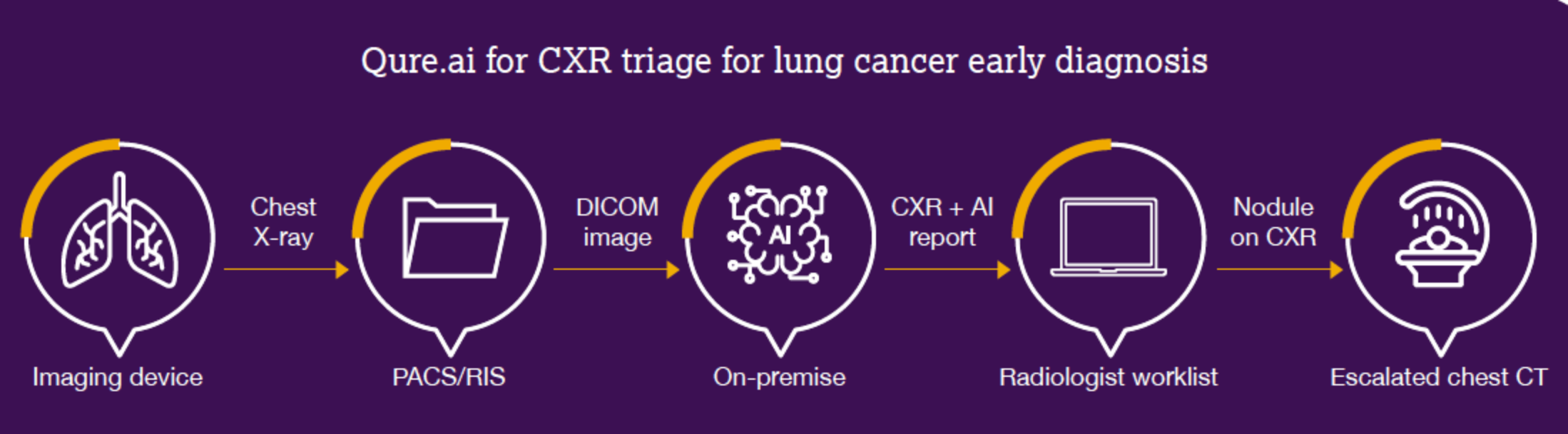
The project aims to show the positive impact that AI-enabled triage of chest X-rays (CXRs) has on timely lung cancer diagnosis, which is associated with improved outcomes. We are leveraging Qure.ai’s technology across seven NHS Trusts in Greater Manchester, to interpret CXRs using deep-learning algorithms to detect cancer and support radiologists by classifying X-rays as remarkable or unremarkable, identifying abnormal findings and highlighting them on the X-ray.
It is hoped that this pilot will generate further evidence showing how technology can benefit cancer patients across the UK.
Sure.ai for CXR triage for lung cancer early diagnosis

Our intended impact:
Clinically – to generate UK-specific evidence demonstrating the value of using AI to identify lung nodules, including indeterminate pulmonary nodules (IPNs).
Operationally – to implement AI triage for CXRs in a real-world setting to support lung cancer diagnosis, with a view to expanding the programme beyond the pilot in the future.
Policy – to engage the NHS cancer team with evidence that will contribute towards the lung cancer diagnosis programme through IPN detection.
- AstraZeneca UK Ltd. Data on file. ID: REF-82605. July 2020.
- NHS. Transforming heart failure diagnosis pathway to improve the patient journey. Available at: https://transform.england.nhs.uk/key-tools-and-info/digital-playbooks/cardiology-digital-playbook/transforming-heart-failure-diagnosis-pathway-to-improve-the-patient-journey/. Last accessed: November 2023.
- Bloom Cl, et al. Asthma-Related Health Outcomes Associated with Short-Acting β2-Agonist Inhaler Use: An Observational UK Study as Part of the SABINA Global Program. Adv Ther. 2020; 37:4190–4208.
- Fingertips Public Health Data. Public health profiles. Available at: https://fingertips.phe.org.uk/search/asthma#page/4/gid/8000003/pat/220/par/E54000051/ati/167/are/E38000085/iid/93573/age/298/sex/4/cat/-1/ctp/-1/yrr/1/cid/4/tbm/1/page-options/tre-ao-1. Last accessed: November 2023.
- Cancer Research UK. Lung cancer statistics. Available at: https://www.cancerresearchuk.org/health-professional/cancer-statistics/statistics-by-cancer-type/lung-cancer#heading-Zero. Last accessed: November 2023.
- Exarchakou A, et al. Socio-economic inequalities in cancer survival: how do they translate into Number of Life-Years Lost? British Journal of Cancer. 2022. 1;126(10):1490-1498.
- Cancer Research UK. Early diagnosis data hub. Available at: https://crukcancerintelligence.shinyapps.io/EarlyDiagnosis/. Last accessed: November 2023.
- Healthcare Safety Investigation Branch. Missed detection of lung cancer on chest X-rays of patients being seen in primary care – independent report by the Healthcare Safety Investigation Branch NI-000836. Available at: https://hsib-kqcco125-media.s3.amazonaws.com/assets/documents/HSIB_Missed_detection_of_lung_cancer_on_chest_X-rays_of_patients_V09.pdf. Last accessed: November 2023.
GB-40199 | DOP: November 2023

